Showing posts with label physiology. Show all posts

Tuesday, September 18, 2018

Renal Failure while on ACE Inhibitor Therapy

Many chronic conditions can lead to renal failure. Hypertension and diabetes can independently cause renal failure. The effect is compounded in patients who have both. Congestive heart failure can also be present and problematic. Medications have been developed that affect the normal physiologic pathways that maintain blood flow to the kidneys in order to both maintain flow and reduce systemic hypertension. Angiotensin converting enzyme (ACE) inhibitors are one common type.

In order for the kidneys to function, blood is pumped through the aorta which supplies the paired renal arteries. Each artery branches multiple times until it reaches the functional unit of the kidney, the glomerulus. Blood flows into the glomerulus via the afferent arteriole and out via the efferent (e for exiting) arteriole. These arterioles are controlled by a hormonal regulation system that helps control how much blood flow and pressure each glomerulus sees.

The hormonal pathway is called the renin-angiotensin-aldosterone (RAS) system. When renal blood flow (RBF) is reduced, cells near the glomerulus called the juxtaglomerular apparatus convert circulating prorenin into renin. Renin catalyzes the conversion of liver-produced angiotensinogen into angiotensin I. This in turn is a precursor for angiotensin II. The conversion is facilitated by angiotensin converting enzyme (ACE) found on the surface vascular endothelial cells, primarily in the lungs.

Angiotensin II has several functions. First, it causes vasoconstriction, primarily at the efferent arteriole. It also stimulates secretion of aldosterone from the adrenal gland, which helps sodium reabsorption and potassium excretion. It also facilitates antidiuretic hormone secretion from the pituitary gland. Generally, angiotensin II wants to preserve circulating volume and blood flow.
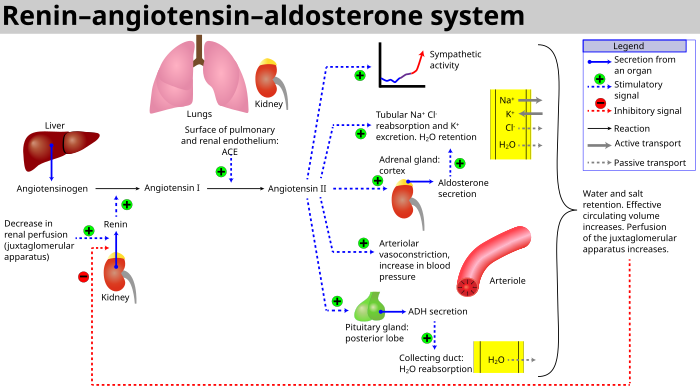
RAAS Schematic
Source: Wikipedia


In normal physiology, renal blood flow (RBF) and glomerular filtration rate are maintained in a narrow range, regardless of blood pressure. Too much RAS activation though can lead to hypertension. Many medications affect particular steps in this pathway to disrupt that activation.

ACE Inhibitors (ACE-i) function by blocking the angiotensin converting enzyme, decreasing the formation of angiotensin II (A-II). This can maintain renal function by decreased vasoconstriction and decreased sodium retention, while increasing renal blood flow. Glomerular filtration rate (GFR) may stay the same or even decrease, due to the differential effects on the afferent and efferent arterioles. Since A-II increases GFR by constricting the efferent arteriole relatively more, blocking A-II will dilate the efferent arteriole to a greater degree. The result is more blood flowing through the kidney overall, but less of it actually being filtered by the glomerulus.

This effect on the kidney is reflected in an expected slight rise in creatinine after initiating ACE inhibitor therapy. The expected rise is usually between 10 and 20%.  Acute kidney insufficiency (AKI) is defined as a rise greater than 0.5 if the serum creatinine was initially less than 2.0 mg/dL or more than 1.0 if the baseline was greater than 2. AKI is exacerbated in patients with congestive heart failure (CHF), and can occur even years after therapy was started.

Four mechanisms have been proposed for how ACE-i cause AKI in this setting. The main mechanism occurs if ACE-i cause the mean arterial pressure to decrease to a point that renal perfusion cannot be maintained. The other causes include: simultaneous diuretic use, NSAID use, or high grade renal artery stenosis.

Presuming the latter three causes have been excluded, ACE inhibitor-induced AKI can be managed with close monitoring of serum creatinine and potassium levels. Hyperkalemia is also common, as blocking A-II causes potassium to accumulate in the circulation. This is exacerbated in patients with diabetes, hyperglycemia, and on beta-blockers (which are common in CHF patients). Once adequately titrated, ACE-i therapy can continue as most induced AKI is reversible and potassium levels can be managed by reducing other potassium-retaining interventions. The long-term benefits of ACE-i should outweigh these short-term issues.  


References:
Schoolwerth AC et al. "Renal Considerations in Angiotensin Converting Enzyme Inhibitor Therapy." Circulation. 2001; 104:1985-1991. 


Thursday, January 20, 2011

Medical Physiology Study Tips

This guest submission by Igor Irvin Bussel, a second year medical student, describes tips on how to study for medical physiology with the aim of acing that inevitable physiology test. 

There is no topic more fascinating in medicine than physiology. Fundamentally, it is the study of life. To be more specific it is the science of function based on integration of systems, communication of signals, and elegant homeostasis.

As a former T.A. for Medical Physiology, I want to help students appreciate and succeed in their course without stress. There is a unique best way to study for each course/professor. I aim to have you study less but in a better fashion because nobody wants to study endless hours and still not score as high as they hoped.

Medical Physiology is a unique course because it is not about memorizing facts but rather
building a mind-set and framework for thinking about the function of the human body. With that in mind, realize that you are not taking medical physiology to become a doctor-- you will learn that by doing. You are a medical student. There is no M.D. after your name... yet. Study for the exams and all else will fall into place.

Even though everyone inherently understands that they have to study for exams, they still
study to be a doctor. Let me repeat and clarify myself: You are studying for exams on medical
physiology. You are not studying medical physiology to become a doctor.

Get the difference?

Once this is clear, you can actually use your exams for what they are-- directions for how to do
well in your medical physiology course.If you just study medical physiology without looking at past exams, you will not do as well on the actual exams as you would like. The course is just too broad for you to base your studies of what you assume to be important. As long as you went to lectures or have even a remote idea of what material you covered, you should take a look at the past exams that are available. Record what topics are addressed most often in questions and hyper-focus your studies to those high-yield areas. You should review all of the material presented but be sure that you have a thorough understanding of the high-yield concepts.

Do not wait to take practice exams days prior because you are not as ready as you would like
to be. You will never be fully ready -- ever. Nor will you achieve perfection. You can however
strive to be excellent. The very act of taking the practice exams will better prepare you for the actual exams and will provide further direction regarding your weaknesses. During your study
sessions, you should be in a constant state of awareness that there are critical points you still have not learned.

When taking the practice or actual exam, always do the easy problems first. Additionally, on
multiple choice sections, your attention should be devoted to finding the wrong answers. Since
there is only 1 correct answer and 4 wrong answers, it is not only easier to eliminate wrong
choices but it also increases the probability of having to make a guess if necessary. While you
are eliminating wrong answers and picking the correct choice, it is crucial to briefly write out your rationale for each decision. This redundancy not only ensures you didn't misread but also primes memories that may be advantageously accessed for later questions. I stress proving wrong and right answers because answer choices on exams are repeated more often than entire questions. More importantly, questions are often changed while answer choices are not.

After any exam, a post-mortem type of analysis must take place. What went well? What went
wrong? Stupid mistakes? Lucky guesses? Constantly evaluate performance, analyze trends, and
implement improvements. Do not waste time engaging in debates on minutiae and rationalization battles. The reality is that most rationalizations are based on faulty assumptions and unless evidence can be provided, these communications are a complete waste of energy, air, and time.


On a final note, while all courses will promote various text books, I think the best sources, if you need them, are the following:

1. Ganong’s Review of Medical Physiology by William Ganong


2. BRS Physiology by Linda S. Costanzo


Igor Irvin Bussel is a second year medical student at Chicago Medical School. Share your passion by publishing your writing on Scrub Notes today!


Updated 2015-12-20

Tuesday, April 29, 2008

Books And Resources For USMLE Step 1

Every U.S. medical student must take and pass Step I prior to becoming a licensed physician. Although Step 2 and 3 are also important, Step I ends up being *the* major test since it is the one residency programs look at when a student applies for a particular program. Having recently taken Step I, here are some resources, both online and books, that I found useful:

Books:
First Aid for USMLE Step I 2008 - An ABSOLUTE essential. This book contains the basic information for the entire test. If you can memorize this entire book, you are almost guaranteed a 240+ score.

BRS Physiology - A solid review of all the physiology you need to know for the test

BRS Pathology - A good companion to the physiology book

Microbiology Made Ridiculously Simple - A good review of microbiology. It probably has much more detail than you need for the test, but combine this with First Aid's microbio, and you're golden.

Pharmcards - Probably more detail than you need for pharmacology, and does contain some errors, but overall, if you know these cards, you're set for the pharm parts of the test

There are several other potentially useful books, but if you use the ones listed here and master them, you will do very, very well.

Online:
Ace Step I Without Becoming a Hermit - another guide to books for Step I written by a HMS student

Goljan Notes - the mythical Dr. Goljan apparently runs Step I review courses. His notes and mp3 lectures are heralded by some. I listened to most of the lectures, but looking back on it, they're probably best started early and listened to in one's spare time

Kaplan QBank - Almost every student will end up doing practice questions in addition to studying. There are several QBanks out there, but Kaplan has a reputation for good results. Try it before you buy it:

Kaplan Test Prep and Admissions (Kaptest.com)


The Challenge consists of a sample set of questions to let you assess how your studying is going, as well as give you a taste of what Kaplan's questions are like. I used them in my preparation, and definitely found it worthwhile. 


Feel free to comment on other resources you find helpful!

LinkWithin

Related Posts Plugin for WordPress, Blogger...

Related Products from Amazon